
Dignity
Language and workflows should respect the young person using them.
A resource list does not solve access if a young person has no way to get there. FCHome exists to close that transportation gap.
FCHome began with the questions that still remain after someone is handed a referral.
Is it still open? Can I get there? What do I do when I arrive?
FCHome is built around those questions. It does not replace trusted providers, case managers, crisis lines, or emergency services.
The long-term vision is a responsible access layer where verified resources, transportation context, and youth-centered next steps work together.
Origin
Two years as a Santa Clara County Youth Crisis Line responder taught Manan the same lesson, call after call: knowing about a resource is not the same as reaching it.
Marcus was 17, just aged out of foster care, with an open leg wound and no ride to the Bill Wilson Center. Manan had nothing to offer but a redirect. Marcus walked there himself.
He became FCHome's first user.
Language and workflows should respect the young person using them.
Resource discovery should include the real-world steps needed to reach support.
FCHome should be clear about limits and never imply emergency guarantees.
Data, sources, verification, and pilot outcomes should be handled honestly.
External validation has helped FCHome reach more youth and operate responsibly at a larger scale.
1st place in California's 18th Congressional District.
Corporate sponsor supporting the platform's ongoing maintenance.
4th place statewide in a community-awareness competition.
Repository material
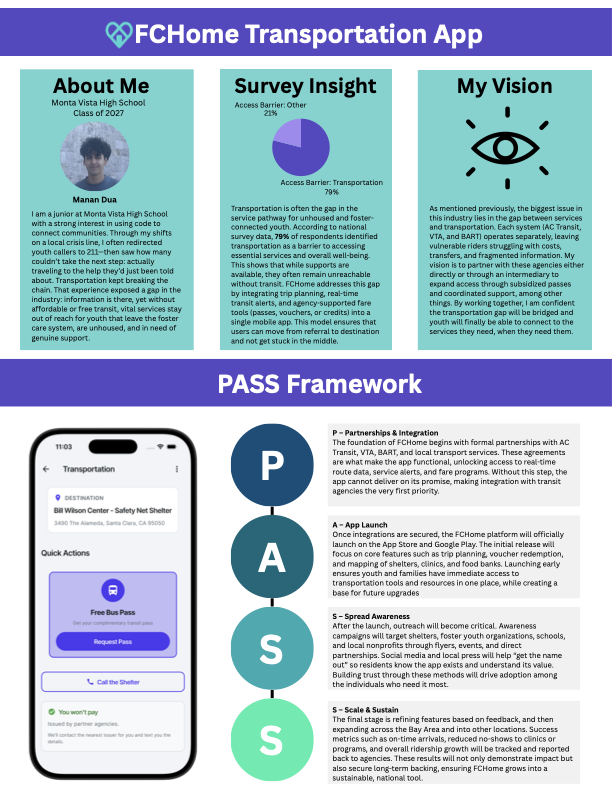
The early proposal connects partnerships, app launch, outreach, and responsible scaling. Claims inside historical materials still require current verification before reuse.
What's Next
Beyond California, Missouri, and Georgia, starting with D.C., Oregon, and New York.
A predictive model flagging eviction filings, utility shutoffs, and unemployment claims before housing is lost.
Bringing the model to city councils across California and FCHome's partner states.
The vision depends on careful pilots, real partner data, ethical research, and transparent claims.